Okay so the last couple months kept me away from devoting myself further to this site, but now I’m back. It’s given me a chance to perhaps adjust and write with a little better flow.
So, anywhere was I?
Oh yeah. Camp. I need to take a moment here and point out that this is one of the most important chapters in the entire franchise. A lot of groundwork gets laid, and, for better or worse, a lot of the rules and basics of the world are established here. And while some of them are more problematic than others, much of universe these books are set in revolve around the setup they describe here.
And this is a desperately needed scene as well. The narrative flow has been really unbalanced so far. A few really quick actions scenes with slow scenes showing Percy being miserable. This scene gives the book the chance to have a better, smoother flow. And that’s not to say that I think that I only want actions scenes. Far from it. One of the biggest problem with actions stories (including the film one based on this book) is an over-emphasis on action over character development and world building.
That’s what this scene is all about. We get to know characters, and see how the world works.
So Percy drifts in and out of consciousness, occasionally seeing a pretty blonde, who feeds him some weird stuff while grilling him about stuff he’s not ready for. “What’s the summer solstice deadline?” And, “What’s been stolen?” Stuff like that. Then again, I could see an argument that he’s ready for literally every question and no question at all at the same time. This massive mind-screw started before the minotaur attacked. This is just the latest in the cavalcade of insanity he’s been dealing with.
Annabeth briefly asks him about something he doesn’t have a clue about, but he’s too groggy to process. All the while feeding him popcorn-flavored pudding. I’m not sure honestly how horrifying that sounds, flavor-wise. It reminds me of the first time I had Jelly Belly jelly beans and was a little unprepared for the very non-candy flavors, and yes popcorn was indeed one of those flavors.
Percy finally comes to seeing Grover, who doesn’t look that different. In fact, he looks similar enough to convince Percy that maybe, just maybe, the whole experience was a fever dream of some kind. He’s giving Percy a drink while standing there. It’s a warm sensation that puts him at ease. Maybe things aren’t so bad for him after all.
And then Grover has to be Grover and ruin it. “You saved my life,” he says, giving Percy the minotaur horn reverently, as if it were a priceless heirloom. I’m not sure how Grover thought this would make Percy feel better. Here, man. It’s the thing you used to kill the thing after it killed your mom. Umm, enjoy!
Grover shows me up with my criticisms of Percy and his self-pity. The only difference is that unlike Percy, Grover’s is absolutely justified. He hasn’t done anything yet to justify why he’s here, or why he’s such a good friend. He’s lied to Percy for months, and he claims he’s supposed to protect him. Then he gets knocked out when it matters the most.
So, while I know there are no doubt people, Percy included, who are willing to defend Grover, or say he’s great friend, I can’t really disagree with Grover’s assessment of himself. “I’m the worst satyr ever.” Yes, Grover. Yes you are.
Percy has been out for two days. I can totally see that. He probably used enough energy for about that many days with that one feat. Defeating something that strong shouldn’t be easy, especially since he had no idea how to fight the thing. He can see a huge meadow with strawberries, a stream, and lots of trees off in the distance. In a pretty good moment, Percy thinks about the tragedy he just suffered, and here there was a beautiful scene all around him, which isn’t something one should see when they’ve lost everything.
That’s how it can feel sometimes. Going to a funeral on a beautiful day, as if the weather and scenery are either mocking you, or apologizing for what just happened.
When Grover kicks his foot, his shoe comes off, and Percy can see that he has a setup to make it look like he has human feet, with styrofoam filling to fit his feet in. That makes sense. If he wants to avoid suspicion, why not do your best to hide that from mortals. Percy imagines that her could see horns on his head if he looked hard for them.
But he can’t be bothered to care at the moment, and I can’t blame him. He’s lost everything important to him, which makes it hard to be impressed at the moment. He feels sorry for Grover, and tries to reassure him that it wasn’t his fault. Not really sure how to judge that, as who real was to blame is kind of up in the air.
Percy tries to move, but he’s still weak from the experience. Grover puts the drink to him, and he drinks it. It looks like apple juice, but tastes like chocolate chip cookies, specifically as Sally made them for him. After he drinks a little, it feels warm, and makes him feel warm, even though there’s still ice in glass.
He drinks it down in a hurry, and feels much better. Grover asks him what it tastes like, but wasn’t wanting a taste. Then asks how Percy feels, which is much, much better. This relieves Grover, as he doesn’t think Percy could handle much more of it. Before he can ask what that means, Grover tells him that it’s time to meet Chiron and Mr. D. Which only leaves Percy with more questions. That’s not getting annoying at all.
I understand that the audience needs to be drip fed a lot of this, as does Percy himself. But this is being overdone. Again, to make the obvious comparison to Harry Potter, he gradually learned things on his own, and when elder characters like Dumbledore withhold information from Harry, it’s because it’s information his classmates aren’t privy to either. This feels more like they’re holding information over Percy’s head for the sake of doing so. If you’re going to keep a character in the dark, there needs to be a legitimate reason for it. There really doesn’t seem to be one here, other than to add dramatic tension. It really makes Percy’s frustration way less whiny and way more understandable.
Percy weakly walks, with the help of Grover through the camp, which he guesses is on the north shore of Long Island, seeing way more than he can process. A canoe lake. A volleyball pit. A climbing wall with lava pouring out. People riding horses, some of them with wings. These are things we’re going to be seeing a lot more of in the future. We’re getting some world building, and a good look at what Percy will be living with going forward.
Then he goes inside to a room where his teacher, Mr Brunner is, alongside a goofy-looking guy in a tiger print shirt. A guy Percy quickly deduces is a guy who likes to drink but is drying out. If anyone was surprised that Brunner would come back, they had to be really young readers.
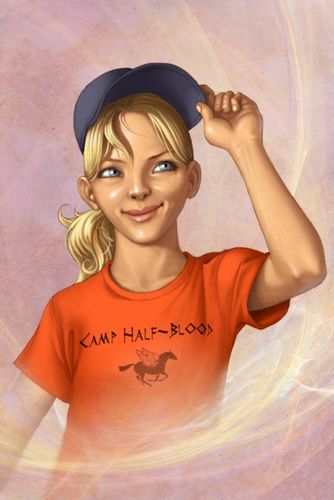
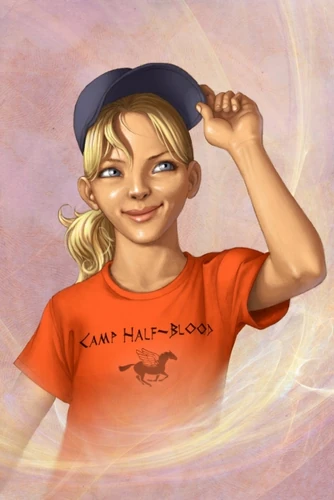
Also in the room is the pretty blonde girl Percy saw in those feverish images he saw after he passed out. It’s pretty clear we’ll be seeing more of her.
But even if we didn’t know what the deal with all of them was, Grover helpfully tells Percy what the score is. The goofy looking guy is Mr. D, the camp director. The pretty blonde is Annabeth, a girl who’s been there longer than just about anyone else there. And, of course, he points out that Percy has already met Chiron. Since Mr. Brunner is the only other person in the room, it’s safe to say that, spoiler alert, Mr. Brunner isn’t really his name.
Brunner, who informs Percy that his name is in fact Chiron, invites Percy to sit down, as now they have four people to play pinochle. Percy notes that Grover is absolutely terrified of Mr. D.
Chiron introduces Annabeth to Percy. She makes a pretty strong impression on him. Looking like a California girl, while at the same time having striking grey eyes that looked like they were sizing him up. And while he has expectations for how she might react to him, she just says, “You drool when you sleep.” Okay. I like her already.
Chiron sends her off to make preparations for Percy at the cabin he’ll be staying at.
And I have to say, I think this is a real missed opportunity. I think it would have been a lot more interesting had they been playing poker. After all, Percy complained endlessly about Gabe and his “stupid poker parties”, so it would have been nice if his first lesson in how different the world is from how he thought had been that sometimes people you like and people you hate like the same thing. Plus, poker is really fun, and can teach you a lot about how to understand people and size up your opponent.
Anway, Percy stupidly doesn’t show enough respect for Mr. D and gets told what for. Even if I didn’t know that there’s more to this guy, he’s still the camp director. He should at least respect that. Chiron tells him that his mother knew about the camp, as it was specifically for people like him. Percy points out that she didn’t want him to go, as he might not come back, and Mr. D snorts that this is usually how they get killed. He’s kinda fun. More of him, please.
But now that they’re settled down, Chiron finally starts to get down to brass tax and tell Percy that the gods of ancient Greece, the Olympians, are very much real. Percy lists off a few of them, and hears thunder overhead. Mr. D warns him against casual usage of names, and tells Percy that names have power.
I feel the need to point out that this is more of an Egyptian thing than Greek. Egyptians did indeed have very elaborate views and even rituals about the sacredness of names and certain names of gods. But Greek? Not so much. It was dumb to use Greek god names as curses, but that’s different from straight up acting like saying their names is taboo. This also kind of causes issues later, as a certain god, or a certain, ahem, titan, becomes a major antagonist, you can’t really go without saying his or her name. A lot. This unfortunately relegates this rule, if you can call it that, to something that will only be used arbitrarily and only when it needs to be a thing.
Percy asks if this means God is real. And Chiron goes into a “God” and “gods” bit, stating that he doesn’t want to go into “the metaphysical.” It’s not quite that simple, but that’s fine. This is clearly the writer wanting to have a book where the Greek gods are real while at the same time not offending the sensibilities of monotheistic readers, which probably make up the overwhelming majority of his readership.
I’m not going to pretend that there’s an easy way to deal with this, but by using it in the way he did, Rick has clearly sent the message that the Greek gods are smaller. To a reader who thinks they’re myths, that’s understandable. However, this is operating in a world where they clearly exist. All I can say that it’s an odd decision to frame it that way. The gods are real, but they’re not really “gods” the way you think. Huh.
Percy protests this concept, insisting that gods are what people believed in before they had science to explain things. Wow. Way to insult the beliefs of countless lives that came before you. I’m not going to go into a deep philosophical discussion about belief, but I do think it’s really insulting to simplify religion or belief in gods as a simple crutch for the ignorant.
I’m actually pretty pleased that Mr. D calls Percy out for this, saying that relying on science as well is arrogant and will likely be considered primitive by people in the future. Chiron further confronts Percy by asking him how he might feel if 3,000 years from now people think he was a myth for how boys deal with the loss of their mothers. He somehow thinks this is Chiron trying to anger him. Personally I think it was Chiron showing him that his world was much bigger than he’d imagined but you can make of that what you will.
Mr. D finished a Diet Coke can he’d been finished, and Grover asks if he can eat it if Mr. D won’t, which he obliges. Sigh. Why is this necessary? Why does Grover have pica, otherwise known as the need to eat inedible objects? I get that in the Disney Hercules movie, Phil had it too, but it was only for one scene. I legitimately don’t understand why the writer included this. It can only distract the reader with silly details in otherwise serious moments. It’s hard to take a scene seriously, if a character is literally eating a napkin like it’s cotton candy.
I can only imagine that it’s done because of the old joke that goats will eat anything. But that largely came from an old Warner Bros. cartoon in the 40’s which really wasn’t meant to be taken as a guide to barnyard biology. It’s not something that’s likely ever to become a plot point, so there’s only so far I can go commenting on it, but to me it’s a pretty annoying detail added for no other reason than to write sight gags that would better translate on screen than in a book, which, as I’ve covered, Rick really seems to like doing.
Mr. D had to change his drink from wine to a Diet Coke because his father restricted him from drinking alcohol for 100 years, while at the same time forcing him to be the director of the camp. When Percy asks who his father is, Mr. D understandably asks Chiron if Percy knows anything at all.
His father is, not at all surprisingly, Zeus. Then Percy starts to put 2 and 2 together, and manages to figure out that Mr. D is in fact Dionysus, god of wine, the discovery of which leads him to an amusing reaction. “Well, duh, Percy Jackson! Did you think I was Aphrodite perhaps?” Again. Dude. Put 2 and 2 together better, Percy.
Even with this news, Percy still reacts skeptically. Then Dionysus looks him in the eyes and gives him visions of the terrible things he could do to Percy’s mind if he so chose. Which, for those who haven’t read the myths, isn’t pleasant.
Chiron wins the game, and Dionysus sighs, and gets up. He informs Grover that he’ll need to have a talk with him about his poor performance. Then he walks off with Grover, telling Percy to go to Cabin 11 and to mind his manners.
Chiron assures Percy that Mr. D isn’t so bad. He just hates being banished from Mt. Olympus. Percy seems a little surprised that Olympus is real. And then Chiron tells him that it’s real both in Greece, and in America.
Apparently the Olympians are the source of western civilization, as Chiron tells it. They move as the heart of The West does. The location moves, like to Rome or England, and the names change, like Zeus to Jupiter, Aphrodite to Venus, but they’ve always been the heart, sustaining it. He points out the symbolism, which is there it one looks for it. The eagle of Zeus on the dollar bill. The statue of Prometheus at Rockefeller Center. This is all because of them.
There are few things that I can’t help but go into here. This is again related to the question of how Greek gods can be real and yet not be smaller in concept. It’s a weird choice, and it only gets weirder, I’m afraid. I’m not crazy about the way Chiron frames this, as it’s giving answers to questions that would have been much more interesting had they been left to the reader to draw their own conclusions from. Maybe there are more than just one god. Or maybe they’re not quite gods the way we commonly think of them. Instead, we get an answer, which doesn’t really feel all that satisfying.
The other thing I have to comment on is the syncretism. This is the act of Assuming Zeus and Jupiter are the same, as are Venus and Aphrodite, and Juno and Hera. On its own, it seems harmless, but again, it’s better to not do things that way. Because if we get stories involving Roman demigods, which, looking ahead we do, this means that we have to make the gods act crazy, with multiple personalities, as there are major differences between the Greek and Roman gods. The biggest example I can think of is the difference between Ares and Mars. Ares was unpredictable and seemed only to revel in violence, while Mars was considered a force for honor and justice in Rome.
As much as people want them to go together, they really don’t.
Percy finally asks Chiron the question that’s been hovering over this whole chapter: who they are, and who he is. Chiron points out that he already told him who they are, and as for him, well, that’s what everyone wants to know. It’s time for him to head to his cabin and meet some new friends.
Then Chiron gets up out of his wheelchair, extending far beyond what he should, by all appearances, and rises to show that his lower half had been that of a horse the whole time. So I guess his wheelchair is a TARDIS or something. Either way, he leads Percy off, and the chapter ends.
WHEW! That took me long enough to cover. And as well, it took care of a metric crap-ton of world building. Though, to be fair, this world building was absolutely necessary. Until now, there’s been absolutely no concept of the stakes of the situation. And while we still don’t know what they really are yet, we’re finally starting to get answers.
The big issues here are the fact that there are universal details that can cause issues if not dealt with in the right way, or at least carefully. While the God vs gods question largely doesn’t come up again, The West and the Greek vs Roman gods issue definitely will come back up, and it’s going to be weird when it does.
Score: 7/10 No action, but it’s the best scene we’ve seen so far. Questions are getting answered, and we’re finally starting to get into the heart of the story.



 A Balloon and Something Bad Happens


![Lightning Thief Cover]](https://images-na.ssl-images-amazon.com/images/I/91RQ5d-eIqL.jpg)